
- Accueil
- Institut Néel
- Équipes de recherche
- Pôles & Services techniques
- Travailler à l’institut
- Partenariats
- Actualités
- Agenda
- Annuaire
The common aim of our research topics is to investigate the new properties, and potentially new functionalities, of low-dimensional systems, arising from the size reduction down to the nanometer scale. We study the structural, magnetic and electronic properties of various systems, such as (ultra)thin films, nanostructures, surfaces and interfaces. In our approach, we control all the processes, from the material elaboration up to the final atomic/electronic/magnetic characterization often in situ or operando.
Besides, we also develop theories for the ab initio simulation and the understanding of experiments related to X-ray absorption and scattering processes.
Synchrotron techniques and the development of original experimental set-ups are among our core activities, frequently coupled to other laboratory tools (variable temperature STM coupled with LEED and in situ MBE growth, magnetometry…). We built several instruments and ensure their joint management at synchrotrons: a resonant X-ray diffractometer at SOLEIL and an UHV diffractometer at ESRF.
Our main research topics are:
Transition metal oxides films show original properties arising from the interplay between charge, spin, orbital and lattice degrees of freedom.
In recent years, we explored :
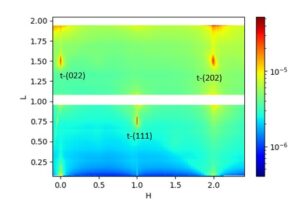
XRD map of an epitaxial tetragonal rock-salt CoxCu1-xO/SrTiO3(001) film. It is represented in substrate reciprocal space units and projected in the HL plane.
Contact : Maurizio.de-santis@neel.cnrs.fr
Students: Anjali Yadav (PhD) 2025-2028
Collaborations:
We investigate magnetic multilayers with layer thicknesses in the nanometer range. We focus on the interfacial effects, complex magnetic configuration, and explore the impact on the magnetic properties of the magnetic anisotropy and of the combination of layers with different magnetic anisotropies. We use various laboratory techniques (X-Ray Reflectivity, Vibrating Sample Magnetometry, SQUID, Spin Hall effect to probe perpendicular magnetization) and the synchrotron radiation technique XRMR (X-rays resonant magnetic reflectivity). We significantly contributed to XRMR developments since its early years, in the late 1990s.This technique, which corresponds to X-ray magnetic circular dichroism (XMCD) in reflectivity condition, makes it possible in the soft x-ray range to study the out-of-plane magnetization profile, with chemical species selectivity.
More recently, we have been using Fourier transform holography and Lorentz microscopy in close collaboration with neighboring UGA laboratories (Université Grenoble Alpes).
The studied systems are either prepared within the SIN team (sputtering or MBE) or come from collaborations.
Contact: jean-marc.tonnerre@neel.cnrs.fr
Collaborations:
Jean-Marc Tonnerre will be leaving the team and join the Laboratoire de Physique des Solides on the Saclay plateau, close to the SOLEIL synchrotron source, in June 2026. Close ties will be maintained with the SIN team
Tridimensional magnetitic objects such as skyrmions are model systems for topologically protected spin textures, emphasizing the role of topology in the classification of complex states of condensed matter.
We develop forefront aspect of this research field by developing and characterizing transition-metal-based magnetic multilayer structures that support skyrmionic states at room temperature and allow for the precise control of skyrmions.
We will use Fourier Transform Holography methods, in collaboration with the SEXTANTS beamline (SOLEIL) and the laboratory SIMAP (Saint Martin d’Hères) to investigate their generation from external parameters (magnetic field, temperature, …).
Our objectives are:
In particularly, a focus is given on multilayers with gradients of composition around the spin reorientation (planar versus magnetic anisotropy).
Contact: farid.fettar@neel.cnrs.fr
Collaboration:
Comprehension of the mechanisms underlying the charge distribution at the electrochemical interface is a fundamental step in sight of catalytic materials performance. At this interface, located between the electrode and the electrolyte, electron exchanges occur that are essential to processes such as corrosion, energy storage in batteries, and electrochemical catalysis. Understanding and controlling this distribution is therefore crucial to ensuring the efficiency, stability, and longevity of electrochemical systems, making it a central topic in research and development in this field.
Combining experimental in situ Surface Resonant X-Ray Diffraction and ab initio calculations with FDMNES, we succeeded in developing an original method to describe the molecular and electronic distribution at the electrochemical interfaces.
We firstly applied this technique to the Pt(111) model system in acidic medium.
Our ongoing work aims at
Contact: Yvonne Soldo, Yvonne.soldo@neel.cnrs.fr
Collaborations:
Titanium dioxide (TiO2) is a wide band-gap semiconductor, with a great variety of applications in different scientific and technological areas of relevance, such as photovoltaics and photocatalysis. Among the different polymorphs of TiO2, anatase shows the best catalytic properties. The most interesting face is the (001) one, but it is also the less stable in nature. Our research, performed in close collaboration with the ICMAB of Barcelona, aims at the growth and characterisation of anatase (001) films.
Contact: Maurizio.de-santis@neel.cnrs.fr
Collaborations:
This research topic is focused on establishing the relationship between the structure of oxide films and their macroscopic properties (magnetic, electronic or optical). It relies on the long-standing experience we have for the controlled synthesis of such systems by MBE (Molecular Beam Epitaxy) and their consecutive in situ or ex situ characterization using laboratory and synchrotron techniques. Typical surface science methods, such as LEED, STM and AES, are complemented by atomically and chemically-resolved synchrotron X-ray-based techniques. Recently, we also took advantage of the capabilities of a new laboratory X-ray diffractometer (SmartLab, Rigaku) to study the crystallographic structure of epitaxial films of VO2 deposited on Al2O3(0001), in collaboration with the MRS team.
Permanent staff : Yves Joly, Yvonne Soldo-Olivier
Former PhD student: Oana Bunau
The purpose of this theme is to improve the understanding and the quantitative analysis of the X-ray spectroscopies as a probe of the electronic and structural properties of the materials. Most often recorded at synchrotron, x-ray absorption spectroscopy, x-ray emission spectroscopy, elastic and inelastic resonant scattering, among other techniques, need the development of tools following the improvements of the experimental capacities. It is the purpose of the FDMNES project
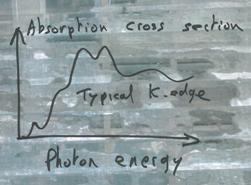 Its aim is to supply to the community a user friendly ab initio code to simulate all these spectroscopies.
FDMNES is mainly mono-electronic and uses the density functional theory (DFT). It includes also multi-electronics advances with the use of the time dependant DFT (TD-DFT) for a better taking into account of the excited states linked to the photon-matter interaction.
More information and download at: http://fdmnes.neel.cnrs.fr
Our team is involved in several instrumental developments linked to synchrotron radiation facilities (ESRF and SOLEIL) and Surface Science techniques:
In laboratory, we manage a surface science set-up that couples surface analysis techniques (Low Energy Electron Diffraction, Auger, Variable-Temperature Scanning Tunneling Microscopy) to in situ Molecular Beam Epitaxy.
Our team takes advantage of the employing of several characterisation techniques:
The study of magnetic configurations in low-dimensional systems requires methods that can both distinguish the different magnetic elements and describe the spatial organization of the magnetization. Resonant X-ray scattering (RXMS) combines X-ray magnetic dichroism, used as a magnetic contrast mechanism, and X-ray scattering techniques to probe the magnetization distribution along the growth axis (specular reflectivity) and in the plane of the sample (non-specular scattering).
During a specular reflectivity measurement, magnetic contrast is highlighted by measuring two intensities, I+ and I–, obtained
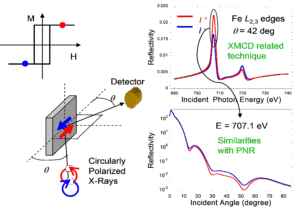 |
Box 1: Basic principle of resonant magnetic reflectivity |
A dedicated software to analyze these measurements was developed: DYNAmic x-ray reflectivity (off- or on- resonance regime for isotropic, anisotropic and magnetic multilayers). DYNA is a simulation tool that allows automatic data refinement to analyze structural, magnetic and electronic profiles along the growth direction of ultra-thin layers. It simulates conventional X-ray or optical reflectivity, resonant (or « anomalous ») x-ray reflectivity, « orbital reflectometry », magnetic resonant X-ray reflectivity with applications to magnetic or anisotropic layers, in hard or soft matter.
Reference: M. Elzo et al., JMMM (2012) 324, 105–112.
More information and download are possible from the MRS team web page.
Reference for instrument: N. Jaouen et al., J. Synchrotron Rad. (2004). 11, 353-357 A new version featuring several improvements, including the new magnetization system, is currently being written.
Permanent staff: Jean-Marc Tonnerre
Collaborations: Stéphane Grenier (MRS team)
In laboratory, we manage a surface science set-up that couples surface analysis techniques (Low Energy Electron Diffraction, Auger, Variable-Temperature Scanning Tunneling Microscopy STM) to in situ Molecular Beam Epitaxy (MBE).
This experimental set-up consists of two interconnected chambers. The sample preparation chamber is fully equipped, with sample heating up to 1000°C, ion sputtering, quadrupole mass spectrometer and several Knudsen cells (MECA2000 and Omicron) for MBE deposition. The characterization chamber is equipped with LEED, Auger, and STM.
Contact: maurizio.de-santis@neel.cnrs.fr
Collaborations: Véronique Langlais (CEMES)
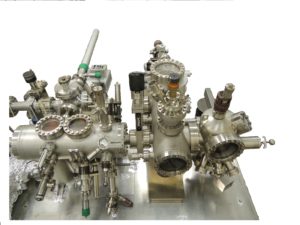
Variable Temperature STM (right) and its UHV preparation chamber (left)
Below is the list of topics proposed by the team for internships, as well as positions with a readily-available funding (PhD, Post-doc and so on).
Sorry ! No job offer at present.
Person in charge: Yvonne SOLDO
Students & Post-docs & CDD
Maurizio DE-SANTIS
Personnel Chercheur - CNRS
Maurizio.De-Santis [at] neel.cnrs.fr
Phone: 04 76 88 74 13
Office: F-409
Farid FETTAR
Personnel Chercheur - CNRS
Farid.Fettar [at] neel.cnrs.fr
Phone: 04 76 88 74 15
Office: F-411
Yvonne SOLDO
Personnel Chercheur - CNRS
yvonne.soldo [at] neel.cnrs.fr
Phone: 04 76 88 74 12
Office: F-408
Jean-Marc TONNERRE
Personnel Chercheur - CNRS
Jean-Marc.Tonnerre [at] neel.cnrs.fr
Phone: 04 76 88 74 15
Office: F-411
Anjali YADAV
Personnel Chercheur - UGA
anjali.yadav [at] neel.cnrs.fr
Office: F-323
Referent: Maurizio DE-SANTIS