Linking the pressure dependence of the structure and thermal stability to α- and β-relaxations in metallic glasses
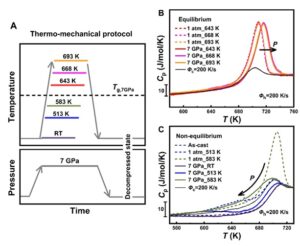
Glasses derive their functional properties from complex relaxation dynamics that remain enigmatic under extreme conditions. While the temperature dependence of these relaxation processes is well established, their behavior under high-pressure conditions remains poorly understood due to significant experimental difficulties. In this study, we employ cutting-edge experimental techniques to probe the pressure evolution of the relaxation spectrum in a Zr46.25Ti8.25Cu7.5Ni10Be27.5 metallic glass across gigapascal pressure ranges. Our findings reveal two distinct relaxation mechanisms under high pressure: In the β-relaxation regime, compression drives the system with reduced atomic mobility and enhanced structural disorder, without significant density changes. Conversely, α-relaxation under pressure promotes density-driven structural ordering that improves thermal stability. Notably, the transition between these regimes occurs at a constant T/Tg,P ratio, independent of applied pressure. These results provide crucial insights for decoupling the competing structural and relaxation contributions to glass stability, establishing a systematic framework for tailoring glass properties through controlled thermo-mechanical processing
Jie Shen, Antoine Cornet, Alberto Ronca, Eloi Pineda et al.