Large exchange bias field in Pt/Co bilayers with ultrathin native oxide
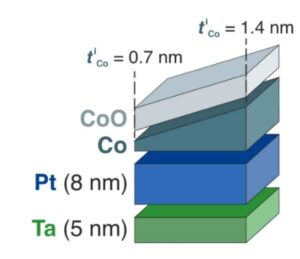
We studied the magnetic properties of a Pt/Co bilayer sample with an ultrathin cobalt layer deposited as a wedge with a thickness between 0.7 and 1.4 nm. After exposure to air, the top 0.5 nm of Co oxidizes, leading to a 0.9 nm-thick CoO surface layer. The residual metallic cobalt is still ferromagnetic at room temperature, with a strong perpendicular magnetic anisotropy even down to 0.2–0.3 nm thickness. These properties are conserved for several months after deposition. Anomalous Hall effect measurements show the presence of an exchange bias field and a blocking temperature between 120 and 150 K, indicating that despite being ultrathin, the CoO layer acquires antiferromagnetic order at low temperatures. We attribute the large exchange bias field (up to 0.9 T at 4 K) to the ultralow thickness of the ferromagnetic Co layer. These results show that simply exposing an ultrathin Co layer to air in order to form a native CoO oxide layer allows obtaining functional properties competing with the best reported so far for optimized Co/CoO layers and core-shell nanoparticles
Agnieszka Klimeczek, Maurizio de Santis, Aurélien Masseboeuf, Jan Vogel, Laurent Ranno , Anne Lamirand, Stefania Pizzini