Research teams
Quantum Electronic Circuits Alps
The team focuses its research on experimental studies to reveal quantum effects in original and novel quantum nano-electronics devices
Goals
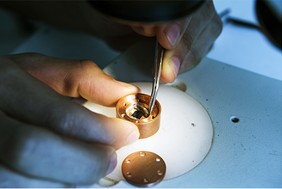
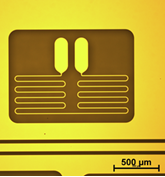
The team members share common research interests and develop original experimental techniques for electronic transport measurements and microwave techniques to observe and control new quantum effects in various different materials. The team’s specificity lies within the quantum nano-electronic circuit itself that defines the novel physics, the material used to build it and the measurement technology. To have access to quantum coherence effects in electronic systems and to their coherent manipulation, very stringent experimental conditions are required such as very low temperature, very low noise and weak measurement signals, microwave techniques as well as high quality nano-fabricated samples.
Original results from the team were obtained also thanks to a continuous effort to develop novel technology (Josephson-junction arrays, scanning probe experiments…) and novel high-quality nanostructures (topological insulators, epitaxially grown superconductors…). During the last 5 years, the team has been strongly involved in building novel experimental set-ups to control multi-qubit systems, to develop quantum-limited amplifiers, to develop opto-electronic techniques compatible with cryogenic environment and to develop cryogenic refrigerators. The team has significantly increased the number of its experimental sites. This was made possible thanks to a strong support of the NEEL technological groups, to grants through funded projects and also to the dynamism and commitment of permanent as well as non permanent researchers.
Overview
The QuantECA team focuses its research on experimental studies to reveal quantum effects in original and novel quantum nano-electronics devices. Its research activities can be decomposed into the following main topics:
- Superconducting qubits
Superconducting circuits including Josephson junctions, coupled to microwave photons - Quantum acoustics/nanomechanics
Preparing mechanical systems in well defined quantum states of motion - Spin qubits
Controlling individual spins in molecular magnets and 28Si-based CMOS circuits - Electronic flying qubits
Moving electrons as vehicles for coherent transfer of quantum information - Technical developments for quantum technologies
Single electron transistors as local probes for scanning-probe microscopy
Superconducting qubits
More information can be found on the website of superconducting quantum circuits (https://www.sqc.cnrs.fr/).
During the last decade, it has been demonstrated that superconducting circuits including Josephson junctions behave as quantum bits and are very well suited to realize advanced quantum mechanical experiments. These circuits appear as artificial atoms whose properties are defined by their electronic characteristics (capacitance, inductance and tunnel barrier).
Moreover, given their mesoscopic size, these quantum bits couple very strongly to electromagnetic radiation in the microwave range. Thus, it is now possible to perform quantum optics experiments using microwave photons and to unravel light-matter interactions using circuits.
In our group, we design and build novel superconducting quantum circuits. One aim is to develop the next generation superconducting qubits (with longer coherence time and/or higher read-out fidelity). We are also interested in using these circuits to explore phenomena that challenge the current understanding of quantum mechanics (e.g. quantum phase slips, quantum phase transition or quantum criticality). Finally we investigate the quantum limits of amplification and microwave detection using such superconducting quantum circuits (with a wealth of application in quantum sensing). These advanced experiments rely on nanofabrication, microwave measurement, very low noise electronics and very low temperature techniques. We benefit from the strong support of the technical groups in Néel Institute and from various national and international collaborations.
High fidelity quantum measurement in transmon qubits
We are studying non-demolition quantum measurements in a quantum system consisting of a superconducting quantum bit (a “qubit”) coupled to a radiative microwave field which carries the information to a classical detector. In an original experiment, we have developed a new coupling between the qubit and the microwave radiation field, called “cross-Kerr”. The qubit itself is realized by an aluminum superconducting circuit containing two Josephson tunnel junctions of submicron size. Electron-beam lithography was used to create a resin mask employed for defining the microwave circuit during thin-film evaporation of the aluminum. The superconducting properties of the circuit are essential for obtaining a non-dissipative microwave oscillator with quality factor as large as 105. In order that thermally-induced quantum fluctuations do not mix the two quantum states, the experiments must be performed at kBT ≪ ℏωqb. The oscillator is held at the very low temperature of 30 mK in a home-made dilution cryostat.
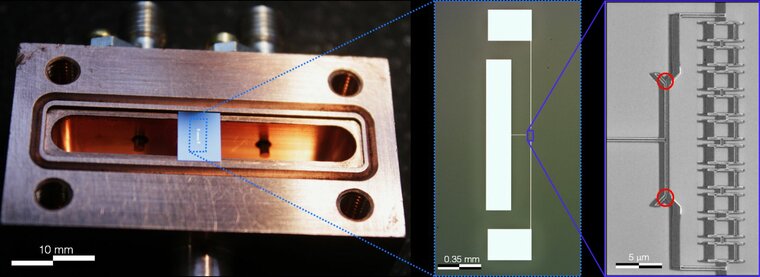
Collaborations: Tomás Ramos and Juan-José García-Ripoll, Quantum Information and Foundations Group, IFF-CSIC, Madrid, Spain.
Publications:
A V-shape superconducting artificial atom based on two inductively coupled transmons, É. Dumur, B. Küng, A. K. Feofanov, T. Weissl, N. Roch, C. Naud, W. Guichard, O. Buisson, arXiv:1501.04892, Phys. Rev. B 92, 020515(R) (2015).
Fast high fidelity quantum non-demolition qubit readout via a non-perturbative cross-Kerr coupling, R. Dassonneville, T. Ramos, V. Milchakov, L. Planat, E. Dumur, F. Foroughi, J. Puertas,S. Leger, K. Bharadwaj, J. Delaforce, C. Naud, W. Hasch-Guichard, J. J. Garcıa-Ripoll, N. Roch, and O. Buisson, Phys. Rev. X 10, 011045 (2020).
Fundings: ANR REQUIEM
FLUXIONIUMS
We work on a highly anharmonic electrical circuit, called Fluxonium, composed of a capacitance, an inductance and a Josephson junction in parallel. By changing the relative value of the energy scales associated to each of these components, we can tailor a large variety of circuits with extremely different properties ranging from high-fidelity qubits for quantum computation, long-lived (protected) qubits with engineered forbidden transitions, or use them as ancillary systems with large quantum fluctuations as a probe of other quantum systems.
Fluxonium is a type of superconducting qubit that can be used in information processing and as a quantum sensor. It was invented in 2009 in the group of Michel Devoret at Yale and gained recently a lot of interest for its potential for Quantum computation. Fluxonium qubits are designed to have certain advantages over the others superconducting qubits, such as longer coherence times and potentially reduced sensitivity to certain types of noise. They consist of a superconducting loop made of a small Josephson junction and a large inductance making it natively sensitive to external magnetic flux.
Fluxonium qubits are still an active area of research in the field of quantum computing and quantum information processing. Scientists and engineers are continually working to improve their performance, reduce error rates, and integrate them into larger-scale quantum computing systems.
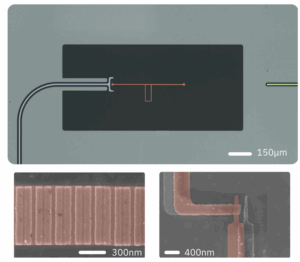
Publication : Waël Ardati, Sébastien Léger, Shelender Kumar, Vishnu Narayanan Suresh, Dorian Nicolas, et al.. Using bi-fluxon tunneling to protect the Fluxonium qubit. Physical Review X, 2024, 14 (4), pp.041014. ⟨10.1103/PhysRevX.14.041014⟩. ⟨hal-04480695⟩
Propagating modes and quantum phase slips in long Josephson junction chains
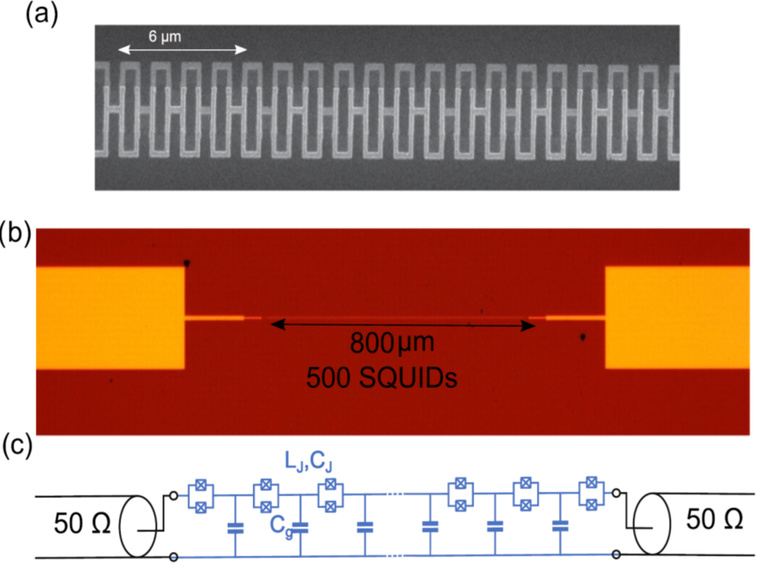
By making arrays of Josephson junction, we can obtain a new type of metamaterials: high impedance and tunable transmission lines. We are studying the dynamics of these chains of Josephson junctions. Plasma modes propagating along the chains have been experimentally and theoretically analyzed as well as their Kerr nonlinearities. In particular we have studied the dispersion and non-linear self- and cross-Kerr frequency shifts of plasma modes in a one-dimensional Josephson junction chain containing 500 SQUIDs in the regime of weak nonlinearity. In the strong quantum fluctuation regime, we studied the effect of the quantum phase slips.
Publications:
Kerr coefficients of plasma resonances in Josephson junction chains, Thomas Weißl, Bruno Küng, Étienne Dumur, Alexey K. Feofanov, Iulian Matei, Cécile Naud, Olivier Buisson, Frank W. J. Hekking, Wiebke Guichard, Phys. Rev. B 92, 104508, (2015).
Kerr nonlinearity in a superconducting Josephson metamaterial. Yu. Krupko, V. D. Nguyen, T. Weissl, E. Dumur, J. Puertas, R. Dassonneville, C. Naud, F. W. J. Hekking, D. Basko, O. Buisson, N. Roch, W. Guichard, Phys. Rev. B 98, 094516 (2018) (2018).
Fundings: ERC FrequJoc
Many-body quantum optics with superconducting circuits
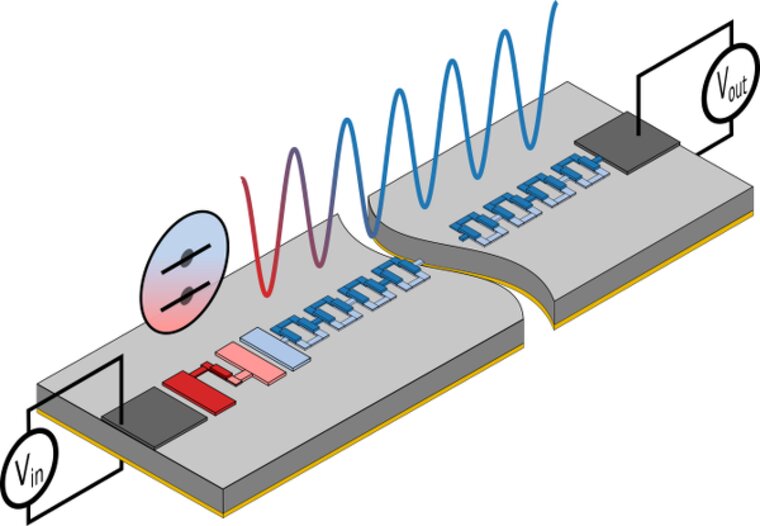
The use of superconducting circuits as building blocks for studying light matter interactions at the fundamental level was introduced more than a decade ago and is named Circuit Quantum ElectroDynamics (circuitQED). With this project we are pushing these ideas to the next level and building circuits to explore many-body quantum optics.
To reach this novel physics, we have developed a unique quantum platform based on superconducting qubits coupled to plasma modes propagating inside an extended Josephson junctions chain. By tailoring the properties of this metamaterial (more specifically its characteristic impedance), we can enhance the qubit-plasma modes coupling up to the ultra-strong coupling regime.
Publications:
Observation of quantum many-body effects due to zero point fluctuations in superconducting circuits, S. Leger, J. Puertas Martínez, K. Bharadwaj, R. Dassonneville, J. Delaforce, F. Foroughi, V. Milchakov, L. Planat, O. Buisson, C. Naud, W. Hasch-Guichard, S. Florens, I. Snyman, and N. Roch, Nature Communications 10, 5259 (2019), Arxiv | Nat. Commun.
A tunable Josephson platform to explore many-body quantum optics in circuit-QED, J. Puertas Martinez, S. Leger, N. Gheereart, R. Dassonneville, L. Planat, F. Foroughi, Y. Krupko, O. Buisson, C. Naud, W. Guichard, S. Florens, I. Snyman, N. Roch, npj Quantum Information 5, 19 (2019), Arxiv | npj Quantum Information
Particle production in a waveguide ultra-strongly coupled to a qubit, N. Gheeraert, X. H. H. Zhang, S. Bera, N. Roch, H. U. Baranger and S. Florens, Physical Review A 98, 43816 (2018), Arxiv | Phys. Rev. A
Fundings: ANR CLOUD, LANEF, ANR BOCA, QuantERA SiUCs
Near quantum limited amplifiers
Measuring these microwave photons with very high quantum efficiency remains a tremendous challenge, since the energy conveyed by one single microwave photon is hundreds thousand times smaller than the one of usual optical photons. Yet signals at the single-photon level can be measured using Josephson parametric amplifiers.
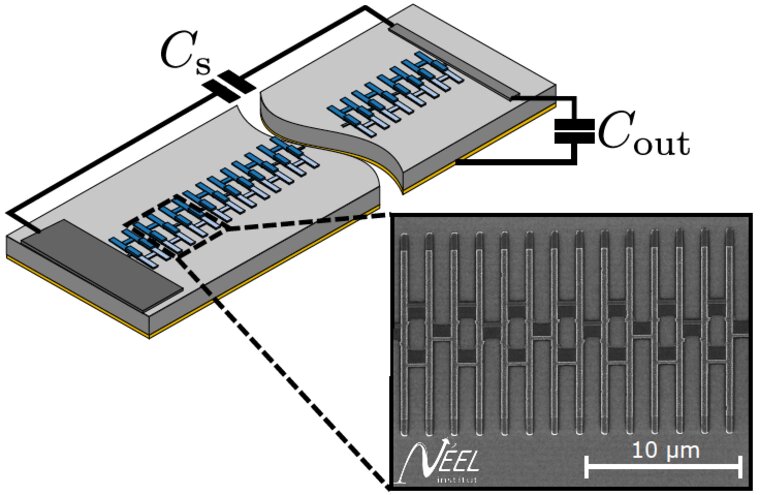
In our team we are now using superconducting metamaterials (see figure) to engineer the next generation of parametric amplifiers. These new devices allow us to explore the quantum limits of amplification as well as to perform quantum optics experiments.
Publications:
A photonic crystal Josephson traveling wave parametric amplifier, L. Planat, A. Ranadive, R. Dassonneville, J. Puertas Martínez, S. Leger, C. Naud, O. Buisson, W. Hasch-Guichard, D. M. Basko, and N. Roch, Physical Review X 10, 021021 (2020) Arxiv | Phys. Rev. X. See also Physics Synopis: A Simple Solution for Microwave Amplification and CNRS la lettre innovation: Un amplificateur quantique pour la lecture des bits quantiques.
Non-degenerate parametric amplifiers based on dispersion engineered Josephson junction arrays, P. Winkel, I. Takmakov, D. Rieger, L. Planat, W. Hasch-Guichard, L. Grünhaupt, N. Maleeva, F. Foroughi, F. Henriques, K. Borisov, J. Ferrero, A. V. Ustinov, W. Wernsdorfer, N. Roch, and I. M. Pop, Physical Review Applied 13, 024015 (2020), Arxiv | Phys. Rev. Applied
Fabrication and characterization of aluminum SQUID transmission lines, L. Planat, E. Al-Tavil, J. Puertas Martínez, R. Dassonneville, F. Foroughi, S. Leger, K. Bharadwaj, J. Delaforce, V. Milchakov, C. Naud, O. Buisson, W. Hasch-Guichard, and N. Roch, Physical Review Applied 12, 064017 (2019), Arxiv | Phys. Rev. Applied
Understanding the saturation power of Josephson Parametric Amplifiers made from SQUIDs arrays, L. Planat, R. Dassonneville, J. Puertas Martínez, F. Foroughi, O. Buisson, W. Hasch-Guichard, C. Naud, R. Vijay, K. Murch, and N. Roch, Physical Review Applied 11, 034014 (2019), Arxiv | Phys. Rev. Applied
Fundings: ANR CLOUD, LANEF, ANR BOCA, QuantERA SiUCs
Hybrid Al/Ge super/semi-conducting crystalline nanowire heterostructures
Hybrid superconducting-semiconducting systems are promising candidates for nano-electronic quantum devices including qubits and quantum circuits. In collaboration with the Institute of Solid-State Electronics at TU Wien, Vienna, Austria and IRIG/LEMMA in CEA Grenoble, we have fabricated and characterised hybrid nanowire aluminium/germanium/aluminium heterostructures. A novel annealing technique allows to reach atomically precise interfaces. Measuring at low temperature, we have demonstrated the exceptional electrical transport characteristics of these high-quality nanowires heterostructures. By tuning with a single gate, we observe from single hole quantum dot to Josephson effect regimes.
Having overcome the limitations of interface defects, the presented results establish Ge quantum dots in an hybrid superconductor-semiconductor Al-Ge-Al nanowire heterostructures as potentially interesting platform for the study of Majorana zero modes and key components of quantum computing such as gatemons qubits or gate tunable SQUIDS.
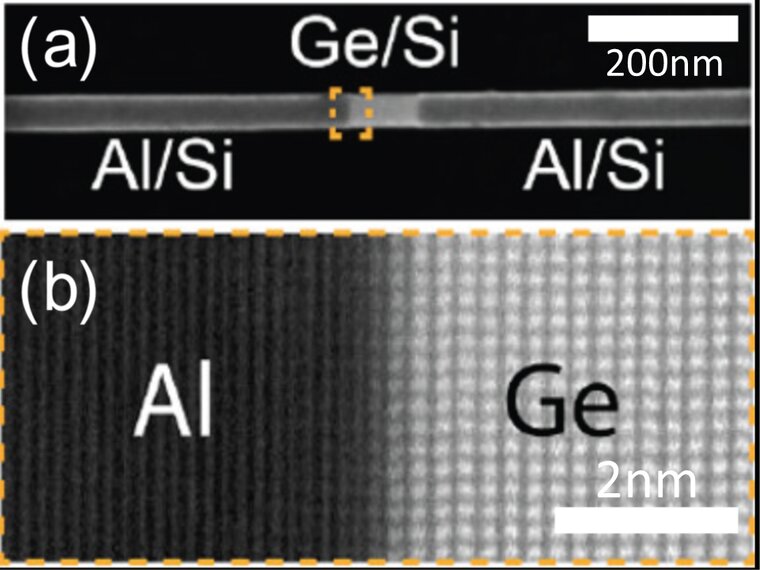
Collaborations: Alois Lugstein and Masiar Sistani, Institute of Solid-State Electronics at TU Wien, Vienna, Austria
Publications:
Highly transparent contacts to the 1D hole gas in ultra-scaled Ge/Si core/shell nanowires, M. Sistani, J. Delaforce, R. Kramer, N. Roch, M.A. Luong, M.I. den Hertog, E. Robin, J. Smoliner, J. Yao, C.M. Lieber, C. Naud, A. Lugstein, O. Buisson, ACS Nano 13, 12, 14145-14151 (2019).
Coulomb blockade in monolithic and monocrystalline Al-Ge-Al nanowire heterostructrures” by M. Sistani, J. Delaforce, K. Bharadwaj, M. Luong, J. Nacenta, N Roch, M. den Hertog, R. Kramer, O. Buisson, A. Lugstein and C. Naud, , Appl. Phys. Lett. 116, 013105 (2020).
Fundings: ANR QPSNanowires, COFUND Greque
Quantum acoustics/nanomechanics
Using piezoelectric materials, acoustic vibrations can now be directly coupled to superconducting circuits. Within this emerging field of research, we develop devices based on this effect to explore its ultimate limits and to engineer new functionalities. Our devices have perspectives in quantum technologies going from quantum sensing (such as acoustic spin detection) to hardware for quantum information science (such as quantum interconnects).
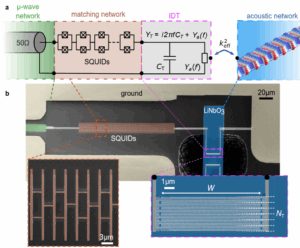
Connecting Josephson circuits and acoustics networks
Recent progress in nanofabrication techniques has enabled the integration of piezoelectric nanostructures with superconducting microwave circuits. This technology provides a direct coupling between the motion of acoustic (mechanical) oscillators and the electric field of superconducting circuits. Combining these two worlds offers novel functionalities for both. The toolbox offered by Josephson circuits benefits to acoustic devices by enabling powerful quantum control techniques. Conversely, acoustic/mechanical degrees of freedom have specific properties (mass, slow phase velocity), that can open new perspectives for superconducting circuits.
Probing quantum systems with acoustic probes
By expanding the spectroscopic tools available in microwave circuits to the acoustic realm, we open up the possibility to probe a class of systems that are weakly coupled to electromagnetic fields, but more strongly coupled to motional (or strain) fields. A typical example of such systems are solid-state spins.
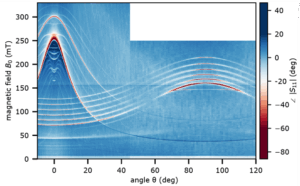
Coherent microwave-to-optical transduction
How can we transmit microwave quantum information over long distances and at room temperature? We believe that the answer is to convert quantum microwaves into quantum optics, and we develop innovative devices that perform this conversion. These devices will for example enable optically-mediated entanglement of distant qubits operating at microwave frequencies. This technology will not only enhance the scalability of quantum computing architectures but also bridge the gap between microwave qubits and silicon photonics, opening new perspectives for both fields.
Funding: ANR Q-MagMech, ANR STOUT, PEPR RobustSuperQ, PEPR QuMOMI
Spin Qubits
Spin qubits in semiconductor quantum dots
| Quantum computing is a major new frontier in information technology with the potential for a disruptive impact. Many different materials and approaches have been explored so far, with an increasing effort on scalable implementations based on solid-state platforms. Among these, silicon is emerging as a promising route to quantum computing and quantum sensing. Elementary silicon qubit devices made in academic research labs have already shown high-fidelity operation. Following these successful developments, a collaborative research action is being deployed in Grenoble with the purpose to take this technology to the next readiness level by showing that silicon-based qubits can be realized within an industry-standard platform. In doing so we want to establish the true potential of silicon-based qubits in terms of scalability and manufacturability. In particular we tend to explore the following points: |
Array of spin qubits in a CMOS device |
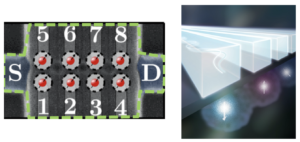
Single-shot readout and coherent manipulation of spins in CMOS devices for quantum technologies
Scalability is one main challenge in the field of quantum computation. Therefore, qubits compatible with CMOS (complementary-metal-oxide- semiconductor) fabrication techniques would be the ultimate solution to scale up qubit systems. While silicon fabrication in small scale lacks in accuracy, necessary for these devices, processes developed in industrial 300 mm founderies achieve high accuracy and reliability. Therefore, the devices are fabricated in a semi-industrial cleanroom at the CEA-LETI.
Our objective is to develop scalable methods to read and manipulate spin qubits in fast and efficient way.
Coherent manipulation of spin qubits using displacement
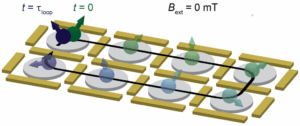
When a quantum system performs a closed loop in a parameter space, its state undergoes a transformation that depends only on the geometry of the path followed and on the characteristics of the underlying Hilbert space. The path-dependent transformations, that are called either Wilczek-Zee holonomies or Berry phases depending on whether the quantum system considered is degenerate or not, have numerous consequences in condensed matter systems. While many experiments have demonstrated the existence of Berry phases in electronic systems, experimental studies of Wilczek-Zee holonomies remain scarce.
We propose to develop an experiment where single holes in germanium heterostructures are displaced in closed loops inside 2D quantum dot arrays at zero magnetic field. Studying the evolution of their pseudospin states depending on the trajectories, we aim at evidencing the Wilczek-Zee holonomies experienced by single spins in presence of a spin-orbit field and investigate the properties of these holonomies.
Spin Qubit as quantum sensor
This project proposes to investigate the use of spin qubit to sense quantum object at low temperature. On the one hand, spin qubits are sensitive to external magnetic field and one possible application is the detection of quantum magnetism at very low temperature where other methods are not accessible. On the other hand, spin qubit can be sensitive to electric field through spin orbit interaction. Therefore, a second application we intend is to detect single electron excitation in quantum circuit with applications in condensed matter and mesoscopic physics.
Main collaborations: CEA-LETI, CEA-IRIG, Spintec
Technical support : nanofab, pole électronique and pole ingénierie expérimental
For more informations please visit:
https://neel.cnrs.fr/equipes-poles-et-services/circuits-electroniques-quantiques-alpes-quanteca
Contacts:
Electronic flying Qubits
Electronic flying qubits
Information processing typically takes place in the nodes of the quantum network on locally controlled qubits, but quantum networking would require to exchange information from one location to another. It is therefore of prime interest to develop ways of transferring information from one node to the other. A particular appealing idea is to use a single flying electron itself as the conveyor of quantum information. Such electronic flying qubits allow performing quantum operations on qubits while they are being coherently transferred. The availability of flying qubits would also enable the possibility to develop new non-local architectures for quantum computing with possibly cheaper hardware overhead than e.g. surface codes.
The aim of our research is to establish a unique innovative platform for creating, manipulating and detecting single-electron wave packets in semiconductor quantum circuits and exploit them for quantum technologies as well as for fundamental science.
Flying Electron Qubits
Our team is developing a pioneering platform to create, manipulate, and detect single-electron wave packets in semiconductor quantum circuits — a major step toward realizing quantum technologies based on flying electron qubits.
Controlling and coherently guiding single electrons opens new possibilities for quantum information processing. In contrast to photons, which are non-interacting quantum particles, electrons naturally interact through the Coulomb force. This fundamental difference opens the door to direct two-qubit gates and entanglement generation — capabilities that are challenging to achieve in photonic systems. Moreover, because electrons move about a thousand times slower than light, their trajectories and quantum states can be manipulated in real time, offering a new level of control for quantum experiments. This makes electronic flying qubits an attractive alternative to photonic systems, combining interaction-based functionality with fine temporal control.
Our recent experiments demonstrate the on-demand injection of ultrashort single-electron plasmonic pulses into a Mach–Zehnder interferometer, maintaining quantum coherence even in the high-frequency, non-adiabatic regime. These results highlight the robustness of quantum interference at the single-electron level and establish a new framework for ultrafast quantum electronics.
Flying electron qubits thus offer a promising path toward compact, scalable quantum processors with enhanced connectivity — an exciting step forward in merging quantum optics concepts with solid-state nanotechnology. Ultimately, this technology could lead to compact, scalable quantum processors with enhanced connectivity — offering a powerful alternative to localized qubit architectures.
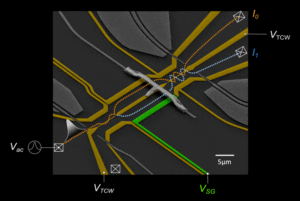
An example of a flying-electron qubit circuit: An ultrashort single-electron wave packet (≈30 ps) is injected into an electronic Mach–Zehnder interferometer engineered within a two-dimensional electron gas in a GaAs semiconductor heterostructure. By applying suitable gate voltages to the tunnel-coupled wires (TCWs), beam splitters are implemented at both the entrance and exit of the interferometer. Quantum-coherent oscillations are observed in the output currents I₀ and I₁ when varying either the magnetic field or the side-gate voltage (VSG) [Ouacel et al., Nat. Commun., 2025].
Further reading:
- C. Bäuerle, et al, Coherent control of single electrons : a review of current progress, Rep. Prog. Phys. 81 056503 (2018)
- P. Delsing et al., The 2019 Surface acoustic waves roadmap, Topical Review, J. Phys. D: Appl. Phys. 52 353001 (2019)
- S. Takada et al, Sound-driven single-electron transfer in a circuit of coupled quantum rails, Nat. Commun. 10, 4557 (2019)
Highly-controlled collisions with single electrons:
Collisions — whether between elementary particles or between large assemblies of them — have long served as powerful probes of collective behavior in matter. From the formation of quark–gluon plasma in heavy-ion collisions to the expansion dynamics of ultracold quantum gases, such experiments reveal how complex many-body states emerge from fundamental interactions. At the nanoscale, their counterparts — mesoscopic electron colliders — have offered striking insights into the quantum world, uncovering exotic excitations such as fractional charges, levitons, and anyons. Yet, a central question remains: how does the transition occur from simple two-particle collisions to the rich collective phenomena that emerge when many particles interact? Bridging this gap at the microscopic level continues to be one of the most compelling challenges in modern quantum physics.
In our team we study how sound waves can move and control single electrons with exceptional precision, allowing us to perform controlled collision experiments at the nanoscale. In our experiments, individual electrons are trapped in tiny on-chip electrostatic “droplets” and then carried along by surface acoustic waves — ripples that travel across the surface of a semiconductor. These electrons can be guided to meet and collide at a beam splitter, where their interactions reveal the fundamental rules of quantum mechanics.
This level of control opens exciting possibilities for quantum technologies, such as implementing two-qubit gates and creating entangled electrons in motion. Beyond applications, this platform also serves as a unique way to realize, within a solid-state chip, an analogue of the Ising model on a complete graph — bringing a powerful theoretical concept into the laboratory.

An electron droplet containing five electrons is launched and split at a Y-junction, where its individual constituents are detected by single-shot detectors D1 and D2. By analyzing the partitioning statistics, one can extract high-order correlation cumulants, providing deep insights into the collective dynamics and phase transitions of quantum chromodynamic (QCD)-like matter [Shaju et al., Nature, 2025].
Further reading
- J. Shaju, et al. Evidence of Coulomb liquid phase in few-electron droplets, Nature 642, 928–933 (2025); https://doi.org/10.1038/s41586-025-09139-z
- J. Wang, et al., Anti-bunching of an electron pair surfing on sound, Nature Nanotechnology 18, 721-726 (2023); https://doi.org/10.1038/s41565-023-01368-5
- Wang, et al., Generation of a single-cycle acoustic pulse – a scalable solution for transport in single-electron circuits, Phys. Rev. X 12, 031035 (2022); http://doi.org/10.1103/PhysRevX.12.031035
Contact: Christopher Bauerle
Technical developments for Quantum Technologies
Single electron transistor microscopy of two dimensional electron systems
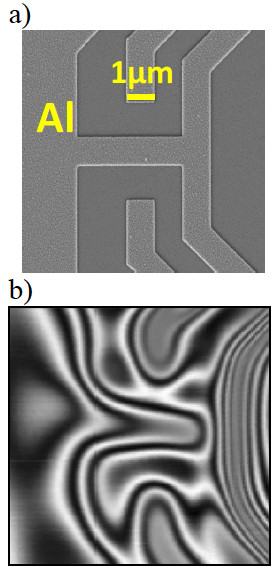
a) Test sample with Al electrostatic gates b) Scanning single electron transistor image of the test sample.
A number of phenomena in condensed matter physics lead to an inhomogeneous distribution of a physical quantity. For example, the flux distribution in superconductors or the electron density of states of a semiconductor. A direct visualisation of these inhomogeneous states is often the only way to reveal their existence. In a bulk measurement without spatial resolution these effects may stay hidden. Scanning probe microscopy allows the visualization of a physical quantity by scanning the surface of interest with a very small detector or probe. The images represent high resolution maps of the specific property probed by the detector. Today these techniques are a key tool in nanoscience and nanotechnology.
In this project, we use a scanning single electron transistor microscope at low temperatures (< 300 mK) and high magnetic fields (0–18 T). This microscope has been recently developed at Néel Institute and is now fully operational. The probe, a single electron transistor, allows very sensitive electric charge detection at the nanoscale. With such a scanning probe microscope most of the two-dimensional electron systems can be studied. Some prominent systems are edge channels in the quantum Hall regime, surface states of three dimensional topological insulators or inhomogeneous electronic states close to a metal-insulator phase transition.
Transport measurements can be done simultaneously in situ which allows a careful characterisation of the sample close to a phase transition. A direct visualisation of these states are key to the fundamental understanding of these phenomena.
Techniques
Nanofabrication
In PTA and Nanofab clean rooms, both at Grenoble, we have access to state of the art clean-room facilities:
- 100 keV e-beam writer (PTA Grenoble)
- 20 keV e-beam writer (Nanofab)
- Laser lithography (Nanofab)
- MJB3 optical lithography system (Nanofab and PTA)
- Dry etching: ICP, IBE, deep ICP, Cl ICP…
- Various types of evaporators, with different condition (ultra-high vacuum, with preparation Ag chamber, multi evaporation…)
- Sputtering machine for oxides and metals
Cryogenics
Our group is specialized in transport measurement at very low temperatures. This requires skills in cryogenics and specific wiring. Here are some examples of dilution fridges :
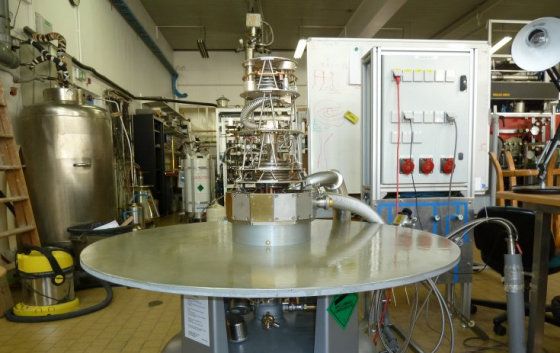 |
Dilution fridge called “SIONLUDI” This is an inverted fridge with large space for RF electronics and a base temperature close to 20 mK (cooling power: 250 µW). It is wired with 8 RF coax lines, 16 thermocoax wires and 27 manganine wires filtered with ECOSORB. It is equipped with a small, fast magnet that can generate a magnetic field up to 1 T. |
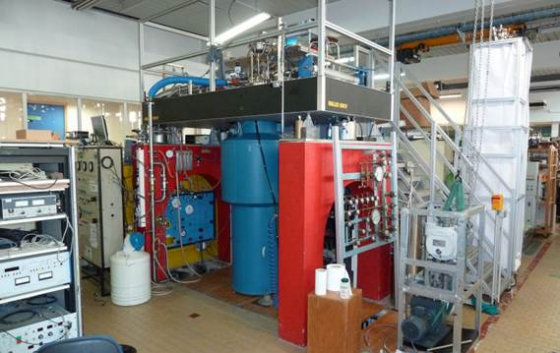 |
Dilution fridge called “WODAN” This is a wet dilution fridge with large space for RF electronics and a base temperature close to 20 mK (cooling power: 1 mW). It is wired with 8 RF coax lines and 27 thermocoax wires. It is equipped with a two axis magnet 6 T/3 T |
Electronics
In collaboration with the “pôle electronique” of the Néel Institute, we are developing low noise electronics (such as current amplifiers, low noise and highly stable DACs, voltage amplifiers) but also RF electronics (such as RF amplifiers, RF-DACs).
Education
Master degree courses (Quantum Information Quantum Engineering)
- Solid State Qbits
- Quantum algorithm practicals – IBM-Q
- Qbits measurement practicals
- QIQE and Nanophysics seminars